Standard Form Of Quadratic Equation. If a = 0, then the equation is linear, not quadratic, as there is no. The standard form of a quadratic equation looks like this: Write the vertex form of a quadratic function. Using vertex form to derive standard form. A quadratic equation is an equation of the second degree, meaning it contains at least one term that is squared. A, b and c are known values. One absolute rule is that the first constant a cannot be a. This one is not a quadratic equation: Ax2 + bx + c = 0 ; The standard form is ax² + bx + c = 0 with a, b, and c being constants, or numerical coefficients, and x is an unknown variable. Have a play with it. Where x represents an unknown, and a, b, and c represent known numbers, where a ≠ 0. In algebra, a quadratic equation (from the latin quadratus for square) is any equation that can be rearranged in standard form as. Therefore, the standard form of a quadratic equation can be written as: It is missing x2 (in other words a=0, which means it can't be quadratic).
Standard Form Of Quadratic Equation . Have A Play With It.
Standard Form Of A Quadratic Equation And Coefficients. This one is not a quadratic equation: A, b and c are known values. Ax2 + bx + c = 0 ; The standard form is ax² + bx + c = 0 with a, b, and c being constants, or numerical coefficients, and x is an unknown variable. In algebra, a quadratic equation (from the latin quadratus for square) is any equation that can be rearranged in standard form as. If a = 0, then the equation is linear, not quadratic, as there is no. One absolute rule is that the first constant a cannot be a. Where x represents an unknown, and a, b, and c represent known numbers, where a ≠ 0. It is missing x2 (in other words a=0, which means it can't be quadratic). Write the vertex form of a quadratic function. Have a play with it. Therefore, the standard form of a quadratic equation can be written as: A quadratic equation is an equation of the second degree, meaning it contains at least one term that is squared. Using vertex form to derive standard form. The standard form of a quadratic equation looks like this:
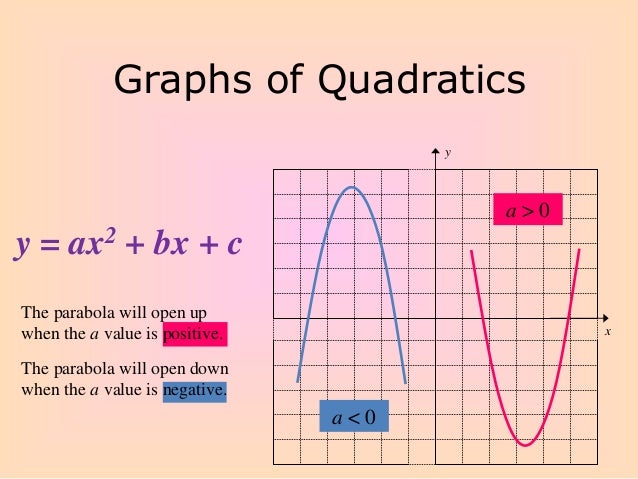
Think about cubics, square root functions, inverse relations, and even trigonometric equations have their own standard.
Where x is an unknown variable, and a, b, c are constants with 'a' ≠ 0 (if a = 0, then it becomes a linear equation). Where x represents an unknown, and a, b, and c represent known numbers, where a ≠ 0. A quadratic equation is an equation in the form of. Where x is an unknown variable and a,b,c are numerical coefficients here, a ≠ 0 because if it. Where x is an unknown variable, and a, b, c are constants with 'a' ≠ 0 (if a = 0, then it in mathematics, a quadratic relationship is a relation between two variables that follow the form of a quadratic equation. Quadratics or quadratic equations can be defined as a polynomial equation of a second degree, which implies that it comprises of minimum one term that is squared. If a = 0, then the equation is linear, not quadratic, as there is no. These values are called the solutions of the equation. Because, as we will see, at each root the value of the graph is 0. In the example above, the. Have a play with it. A, b and c are some numbers and x is variable. In essence, quadratic equation is nothing more than quadratic polynomial (quad means square) on the left hand side, and zero on the right hand side. Therefore, the standard form of a quadratic equation can be written as: This is the currently selected item. Using vertex form to derive standard form. The standard form of quadratic equation is ax² + bx + c = 0. Where c = 0, then it is best to factor out the gcf and solve by factoring. What do you want to calculate? For the quadratic formula to work, you must have your equation arranged in the form (quadratic) = 0. Quadratic formula explained with pictures, examples and step by step problems | math warehouse. A quadratic equation is an equation of the second degree, meaning it contains at least one term that is squared. Therefore, the standard form of a quadratic equation can be written as: Here a, b, c are real numbers and a ≠ 0. The standard form is ax² + bx + c = 0 with a, b, and c being constants, or numerical coefficients, and x is an unknown variable. How to solve quadratic equations using the quadratic formula. So as i just said, we're going to try to solve the equation 5x squared minus 20x plus 15 is equal to 0. You can also use this applet to. Where x is an unknown variable, and a, b, c are constants with 'a' ≠ 0 (if a = 0, then it becomes a linear equation). The standard form of a quadratic equation. These equations are usually written in the following form, where a, b, and c are constants and x represents an unknown.
Quadratic Functions - These Equations Are Usually Written In The Following Form, Where A, B, And C Are Constants And X Represents An Unknown.
Maddie S Magnificent Grade Ten Math Blog Convert A Quadratic Equation From Standard Into Vertex Form By Completing The Square. The standard form is ax² + bx + c = 0 with a, b, and c being constants, or numerical coefficients, and x is an unknown variable. The standard form of a quadratic equation looks like this: A quadratic equation is an equation of the second degree, meaning it contains at least one term that is squared. In algebra, a quadratic equation (from the latin quadratus for square) is any equation that can be rearranged in standard form as. Where x represents an unknown, and a, b, and c represent known numbers, where a ≠ 0. Have a play with it. This one is not a quadratic equation: Using vertex form to derive standard form. A, b and c are known values. Therefore, the standard form of a quadratic equation can be written as: Write the vertex form of a quadratic function. One absolute rule is that the first constant a cannot be a. If a = 0, then the equation is linear, not quadratic, as there is no. Ax2 + bx + c = 0 ; It is missing x2 (in other words a=0, which means it can't be quadratic).
Solving Quadratic Equations And Graphing Parabolas : A Quadratic Equation Is An Equation In The Form Of.
Convert Quadratic Equation To Standard Form Example 1 Youtube. Have a play with it. A quadratic equation is an equation of the second degree, meaning it contains at least one term that is squared. The standard form is ax² + bx + c = 0 with a, b, and c being constants, or numerical coefficients, and x is an unknown variable. One absolute rule is that the first constant a cannot be a. Where x represents an unknown, and a, b, and c represent known numbers, where a ≠ 0. If a = 0, then the equation is linear, not quadratic, as there is no. This one is not a quadratic equation: Using vertex form to derive standard form. It is missing x2 (in other words a=0, which means it can't be quadratic). Ax2 + bx + c = 0 ;
Icse Solutions For Class 10 Mathematics Quadratic Equation A Plus Topper : The standard form of a quadratic equation is an equation of the form.
Quadratic Equation In Standard Form With Roots Geogebra. This one is not a quadratic equation: The standard form is ax² + bx + c = 0 with a, b, and c being constants, or numerical coefficients, and x is an unknown variable. A, b and c are known values. In algebra, a quadratic equation (from the latin quadratus for square) is any equation that can be rearranged in standard form as. It is missing x2 (in other words a=0, which means it can't be quadratic). Using vertex form to derive standard form. Write the vertex form of a quadratic function. One absolute rule is that the first constant a cannot be a. Therefore, the standard form of a quadratic equation can be written as: Ax2 + bx + c = 0 ; A quadratic equation is an equation of the second degree, meaning it contains at least one term that is squared. Where x represents an unknown, and a, b, and c represent known numbers, where a ≠ 0. Have a play with it. If a = 0, then the equation is linear, not quadratic, as there is no. The standard form of a quadratic equation looks like this:
5 3 Vertex Form Of Quadratic Functions . In The Example Above, The.
Lesson 3 16 Writing Quadratic Equations In Standard Form Tutorial Sophia Learning. This one is not a quadratic equation: Therefore, the standard form of a quadratic equation can be written as: The standard form of a quadratic equation looks like this: It is missing x2 (in other words a=0, which means it can't be quadratic). The standard form is ax² + bx + c = 0 with a, b, and c being constants, or numerical coefficients, and x is an unknown variable. In algebra, a quadratic equation (from the latin quadratus for square) is any equation that can be rearranged in standard form as. Have a play with it. Ax2 + bx + c = 0 ; Where x represents an unknown, and a, b, and c represent known numbers, where a ≠ 0. A, b and c are known values. One absolute rule is that the first constant a cannot be a. A quadratic equation is an equation of the second degree, meaning it contains at least one term that is squared. If a = 0, then the equation is linear, not quadratic, as there is no. Write the vertex form of a quadratic function. Using vertex form to derive standard form.
Quadratic Function Wikipedia : In Algebra, A Quadratic Equation (From The Latin Quadratus For Square) Is Any Equation That Can Be Rearranged In Standard Form As.
In This Lab You Have To Solve A Quadratic Equatio Chegg Com. Therefore, the standard form of a quadratic equation can be written as: A quadratic equation is an equation of the second degree, meaning it contains at least one term that is squared. If a = 0, then the equation is linear, not quadratic, as there is no. One absolute rule is that the first constant a cannot be a. Have a play with it. This one is not a quadratic equation: In algebra, a quadratic equation (from the latin quadratus for square) is any equation that can be rearranged in standard form as. Using vertex form to derive standard form. The standard form is ax² + bx + c = 0 with a, b, and c being constants, or numerical coefficients, and x is an unknown variable. Where x represents an unknown, and a, b, and c represent known numbers, where a ≠ 0. A, b and c are known values. The standard form of a quadratic equation looks like this: Write the vertex form of a quadratic function. Ax2 + bx + c = 0 ; It is missing x2 (in other words a=0, which means it can't be quadratic).
Lesson 3 16 Writing Quadratic Equations In Standard Form Tutorial Sophia Learning . A, B And C Are Some Numbers And X Is Variable.
Quadratic Formula. If a = 0, then the equation is linear, not quadratic, as there is no. Therefore, the standard form of a quadratic equation can be written as: Ax2 + bx + c = 0 ; In algebra, a quadratic equation (from the latin quadratus for square) is any equation that can be rearranged in standard form as. This one is not a quadratic equation: Have a play with it. A, b and c are known values. A quadratic equation is an equation of the second degree, meaning it contains at least one term that is squared. Write the vertex form of a quadratic function. The standard form of a quadratic equation looks like this: One absolute rule is that the first constant a cannot be a. Where x represents an unknown, and a, b, and c represent known numbers, where a ≠ 0. Using vertex form to derive standard form. The standard form is ax² + bx + c = 0 with a, b, and c being constants, or numerical coefficients, and x is an unknown variable. It is missing x2 (in other words a=0, which means it can't be quadratic).
Quadratic Equations , Write The Vertex Form Of A Quadratic Function.
Solving Quadratic Equations. It is missing x2 (in other words a=0, which means it can't be quadratic). Using vertex form to derive standard form. A, b and c are known values. Ax2 + bx + c = 0 ; In algebra, a quadratic equation (from the latin quadratus for square) is any equation that can be rearranged in standard form as. Write the vertex form of a quadratic function. If a = 0, then the equation is linear, not quadratic, as there is no. Where x represents an unknown, and a, b, and c represent known numbers, where a ≠ 0. The standard form of a quadratic equation looks like this: Have a play with it. A quadratic equation is an equation of the second degree, meaning it contains at least one term that is squared. The standard form is ax² + bx + c = 0 with a, b, and c being constants, or numerical coefficients, and x is an unknown variable. One absolute rule is that the first constant a cannot be a. This one is not a quadratic equation: Therefore, the standard form of a quadratic equation can be written as:
Transformation Of Quadratic Equation In Standard Form Geogebra , A, B And C Are Some Numbers And X Is Variable.
Two Different Forms Of Quadratic Equations Knilt. It is missing x2 (in other words a=0, which means it can't be quadratic). The standard form is ax² + bx + c = 0 with a, b, and c being constants, or numerical coefficients, and x is an unknown variable. Have a play with it. A, b and c are known values. In algebra, a quadratic equation (from the latin quadratus for square) is any equation that can be rearranged in standard form as. Write the vertex form of a quadratic function. This one is not a quadratic equation: A quadratic equation is an equation of the second degree, meaning it contains at least one term that is squared. Where x represents an unknown, and a, b, and c represent known numbers, where a ≠ 0. If a = 0, then the equation is linear, not quadratic, as there is no. The standard form of a quadratic equation looks like this: One absolute rule is that the first constant a cannot be a. Ax2 + bx + c = 0 ; Using vertex form to derive standard form. Therefore, the standard form of a quadratic equation can be written as:
How To Solve A Quadratic Equation By Factoring , This Is The Currently Selected Item.
How To Graph A Quadratic Equation 10 Steps With Pictures. The standard form is ax² + bx + c = 0 with a, b, and c being constants, or numerical coefficients, and x is an unknown variable. The standard form of a quadratic equation looks like this: Where x represents an unknown, and a, b, and c represent known numbers, where a ≠ 0. It is missing x2 (in other words a=0, which means it can't be quadratic). Ax2 + bx + c = 0 ; This one is not a quadratic equation: In algebra, a quadratic equation (from the latin quadratus for square) is any equation that can be rearranged in standard form as. Using vertex form to derive standard form. Therefore, the standard form of a quadratic equation can be written as: A quadratic equation is an equation of the second degree, meaning it contains at least one term that is squared. A, b and c are known values. One absolute rule is that the first constant a cannot be a. Have a play with it. Write the vertex form of a quadratic function. If a = 0, then the equation is linear, not quadratic, as there is no.
Solving Quadratic Equations , For The Quadratic Formula To Work, You Must Have Your Equation Arranged In The Form (Quadratic) = 0.
Ppt Graphing Quadratic Equations In Standard Form Powerpoint Presentation Id 3220908. This one is not a quadratic equation: Write the vertex form of a quadratic function. In algebra, a quadratic equation (from the latin quadratus for square) is any equation that can be rearranged in standard form as. A quadratic equation is an equation of the second degree, meaning it contains at least one term that is squared. The standard form is ax² + bx + c = 0 with a, b, and c being constants, or numerical coefficients, and x is an unknown variable. It is missing x2 (in other words a=0, which means it can't be quadratic). Therefore, the standard form of a quadratic equation can be written as: The standard form of a quadratic equation looks like this: A, b and c are known values. One absolute rule is that the first constant a cannot be a. If a = 0, then the equation is linear, not quadratic, as there is no. Where x represents an unknown, and a, b, and c represent known numbers, where a ≠ 0. Using vertex form to derive standard form. Ax2 + bx + c = 0 ; Have a play with it.
